

Insights
Notes on automation, from inside the work.
Decision frameworks, tool comparisons, cost breakdowns, and workflow patterns written for owners and managers who need to improve operations, not for procurement committees.
Written from the build table
The useful automation questions are usually operational, not technical.
These notes are for owners and managers deciding what is worth automating, which tools to trust, what a workflow should cost, and when doing nothing is the smarter call.
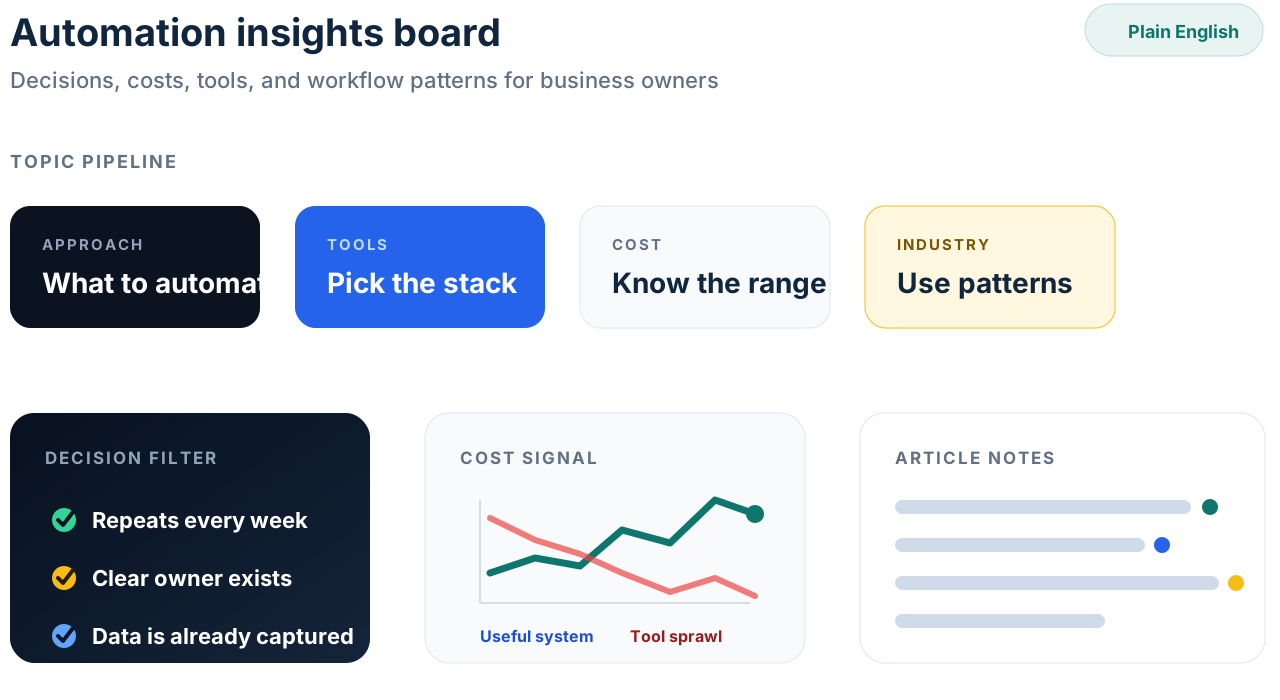
- Approach
- Tools
- Cost
- Industry patterns
- Approach 6 min read
What is actually worth automating in a small business
The right automation candidates share three traits: high frequency, low variability, and a cost of error you can live with. The wrong ones tend to be rare, judgment-heavy, or sitting on top of a process that needs to be redesigned first.
Apr 15, 2026
- Cost 5 min read
The real monthly cost of running an AI workflow
Most AI-assisted workflows for SMEs cost somewhere between a few hundred and a few thousand baht per month to run. The variance comes from how often the workflow runs, how much AI it uses, and which tools it connects.
Apr 8, 2026
- Approach 4 min read
How to tell if you need automation or just better tools
Before you build automation, check whether the workflow you are trying to automate already lives inside a tool that does most of the work natively. Plenty of teams pay for automation when an upgrade or a different SaaS would solve the same problem at a tenth of the cost.
Apr 1, 2026
- Approach 5 min read
When not to automate
Automation amplifies whatever process it sits on top of. If the underlying process is unstable, judgment-heavy, or rarely run, the wrong move is to encode it in software. Six situations where the right answer is to leave it alone.
Mar 22, 2026
- Approach 6 min read
Why automation projects stall before they save money
Automation projects rarely fail because the software is impossible. They fail because scope drifts, ownership is unclear, or the wrong people are at the table. A few scoping decisions made up front prevent most of that waste.
Mar 15, 2026
- Tools 6 min read
Zapier, n8n, or custom code: which to use when
Zapier, n8n, and custom code each win in different situations. The decision usually comes down to integration breadth, data residency, complexity of branching logic, and who will maintain the system.
Mar 8, 2026
- Industry 7 min read
Patterns that come up in hospitality automation
Hospitality is one of the strongest fits for workflow automation in Thailand. Five patterns come up in almost every engagement: lead qualification, review response, guest reactivation, concierge messaging, and operational reporting.
Feb 26, 2026
- Tools 6 min read
Integration without the chaos: keeping your tools in sync
The five-tools-and-four-spreadsheets problem comes from normal growth, not bad decisions. Solving it does not mean moving everything to one platform. It means deciding which tool owns each type of information and connecting the rest around it.
Feb 12, 2026
- Approach 5 min read
Data residency: what Thailand-based businesses should actually worry about
Most SMEs in Thailand do not need to overthink data residency, but a few categories do. The decisions that matter are where customer data is stored, which vendors can access it, and where AI or automation tools process it.
Feb 4, 2026
- Approach 5 min read
Build internally, hire a freelancer, or work with a studio: which to pick when
For SMEs in Thailand, three paths exist for automation work: build with internal capacity, hire a freelancer, or engage a studio with a fixed-scope offer. The decision usually comes down to scope, maintenance, risk, and how much management time is worth.
Jan 28, 2026
Reading is good. Talking is faster.
Half an hour on a real problem usually goes further than ten articles. If something here is making you think, bring it to the call.